Do You Need Different Underlay for Stairs? Buyer Guide
Do You Need Different Underlay for Stairs? What to Know Before You Buy
Ask this question online and you will get a fast, confident answer: yes, use a denser underlay on stairs. That answer is correct as far as it goes, and it is the part almost every supplier will tell you, because it is the part that sells a product.
It is also the least interesting part of the problem.
The thing that actually determines whether a stair carpet still looks good in five years is not which line of the spec sheet you picked. It is whether the underlay was cut and fixed correctly around the nosings, the winders and the gripper rods. A perfectly specified underlay, fitted badly, will fail. A sensible mid-range underlay, fitted properly, will quietly do its job for years. That is why stairs are best treated as a measured, fitted job rather than a shopping list you assemble yourself.
The short version: why stairs are not a lounge floor
In a lounge or bedroom, underlay is mostly about comfort, warmth and sound. Foot traffic spreads across a wide area, and the carpet is stretched flat between grippers at the perimeter.
Stairs are the opposite. Almost every footfall lands on a narrow band of carpet at the front edge of each tread, so the wear is concentrated into a strip a few centimetres wide. The carpet is also wrapped over a hard right angle rather than lying flat, which means the underlay underneath it is being compressed and flexed at the same point over and over again.
Soft, deep underlay is exactly the wrong response to that. It crushes under repeated point loading, and once it has crushed, the carpet above it loses support at the nosing and starts to wear through. A firmer, denser underlay resists that compression and holds the carpet’s shape at the edge. That is the whole argument, and it is well covered elsewhere. Density beats depth on stairs.
What gets far less attention is everything that happens after the product is chosen.
Straight flights, winders and the awkward bit in the middle
A straight flight is the easy case. Every tread is the same width and the same depth, the underlay can be cut in matching rectangles, and the carpet runs in one continuous piece from top to bottom. Even here, the underlay has to stop and start in the right places rather than being wrapped continuously over the nosing, but the geometry is predictable.
Winders change that completely. On a turning staircase, the treads are wedge shaped, each one a slightly different size, and the carpet has to be cut and joined to follow the turn. The underlay underneath has to be cut to match, piece by piece, with each piece sitting cleanly between its grippers. There is no way to do that from a roll bought blind and cut roughly to size in a hallway. Every piece is a separate template.
This is also where thickness stops being a theoretical choice and becomes a physical one. On a shallow tread with a pronounced bullnose nosing, there is only so much room for carpet and underlay to wrap the edge and still be pulled tight and secured underneath. Add a chunky underlay and the carpet can end up standing proud of the nosing, soft and rounded where it should be crisp. That is not just cosmetic. A step edge that feels spongy underfoot reads as unstable, and on a staircase that matters more than anywhere else in the house.
Older properties add their own complications. Treads that have worn hollow, risers that are not square, open-sided flights, a half landing that is not quite level. None of that shows up when you are comparing underlay online, and all of it changes what will actually fit.
Gripper rods and nosing bars: the part nobody photographs
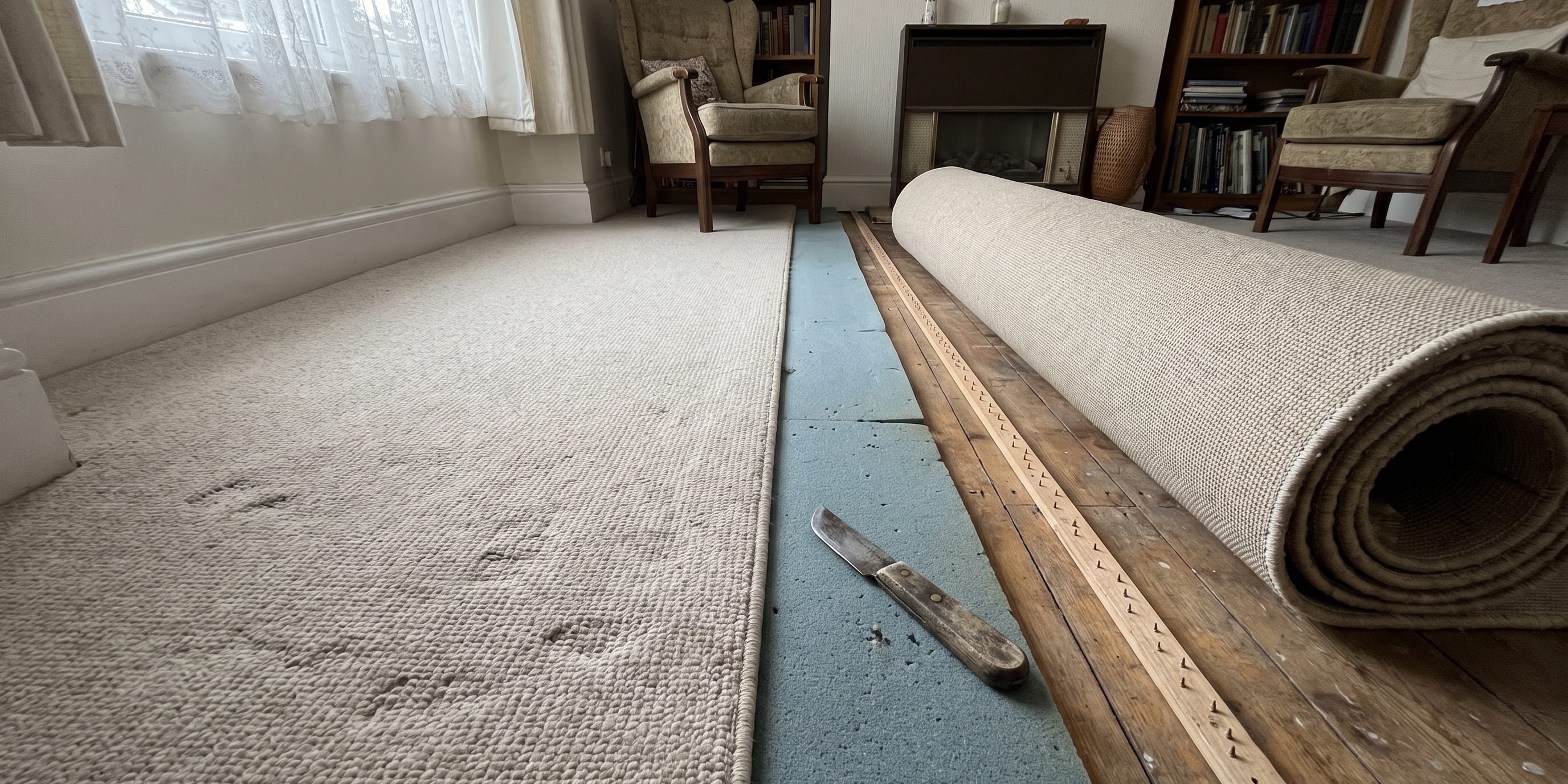
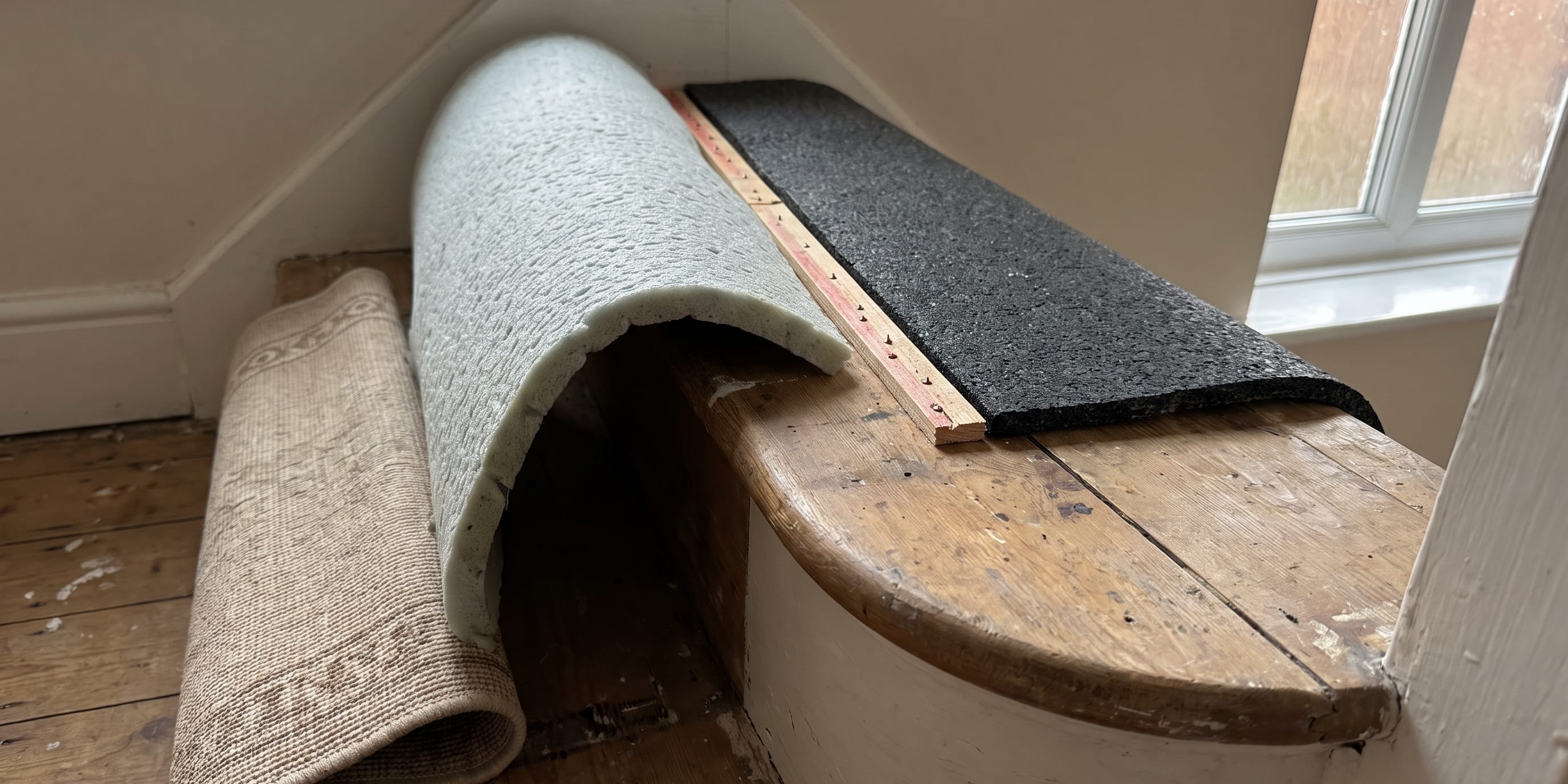
Stair carpet is held by gripper rods fixed at the back of each tread and the bottom of each riser, forming a channel that the carpet is tucked into and gripped by. The underlay sits between those grippers, not over them. Get the gripper spacing wrong and the carpet cannot be tensioned into the angle properly.
Where a stair carpet meets a landing, a hallway or a hard floor, a nosing bar or edge trim may be needed to finish and protect the join. The underlay has to terminate correctly at that point, neither running under the bar and bulking it up nor stopping short and leaving an unsupported gap.
When this is rushed, the results are recognisable:
- Underlay running over the nosing instead of stopping at the gripper. The carpet has nothing firm to grip into, and it gradually loosens off the step edge.
- Grippers set at the wrong distance from the angle. The carpet cannot be tucked in tightly, so you get a soft, slightly open line along the back of each tread.
- Underlay pieces cut short or overlapped. Short pieces leave a step you can feel through the carpet. Overlaps leave a ridge that shows as a wear line within months.
- Old grippers reused when they should have been replaced. Pins lose their bite over time, particularly on stairs that have been recarpeted more than once.
- Staples driven through in the wrong places. On stairs, fixings that miss the underlay edge or catch the carpet pile create wear points and, occasionally, noise.
None of these are exotic failures. They are the ordinary consequences of treating stairs as an afternoon job.
Why buying underlay separately usually costs more in the end
It is entirely possible to buy carpet from one place, underlay from another and fitting from a third. The saving looks real on the day you order. The problems appear later.
The most common one is simple mismatch. The underlay ordered online turns out to be too thick for the nosings, or too soft for the traffic, or the quantity is wrong because stair carpet is not measured the way room carpet is. Winders in particular use more material than people expect, and the offcuts are not interchangeable. If you are short, you cannot always get an identical batch.
Then there is the accountability question. When carpet, underlay and fitting are quoted and supplied as one job, there is one party responsible for the outcome. When they are split, a problem at the nosing becomes a discussion about whether it is the carpet, the underlay or the fitter. That is a conversation nobody wins.
Buying it as a measured job also means the specification is chosen against your actual staircase rather than a generic one. The person measuring can see whether you have a straight flight or a turn, how deep the treads are, what shape the nosings are, whether the existing grippers are sound and where the carpet needs to terminate. Those observations change the recommendation. You cannot make them from a website.
Rented properties, flats and commercial stairs
If the staircase is in a let property, a communal area or a commercial building, the decision widens beyond comfort and wear.
Stairs in these settings are a recognised slip and trip risk, and the surface underfoot is part of that assessment. An underlay that lets the carpet move or feel unstable at the step edge is a genuine liability, not just an annoyance. Firmness matters more here than anywhere.
Fire performance is the other consideration. In communal stairwells and commercial premises, the responsible person has duties around fire safety, and the floor covering build-up can form part of what a fire risk assessment looks at. Carpet and underlay are often assessed together as a system rather than separately, and specifiers or managing agents may ask for documentation of the products used. If you are buying for a block, an HMO or a commercial site, ask up front what performance evidence is available for the combination being proposed, and keep it on file. Do not assume a domestic underlay bought online comes with anything you can hand to an assessor.
What a good stairs quote should actually tell you
When you are comparing quotes, the price per square metre is not the useful comparison. Ask for these instead.
On the underlay itself:
- What product is being proposed, by name, and is it specified as suitable for stairs?
- What is its thickness and density, and why that combination for your staircase?
- Is the same underlay being used throughout, or a different one on the stairs to the rooms?
On the fitting:
- Are new gripper rods being fitted, or existing ones reused?
- How are the winders being handled, and is that reflected in the labour?
- Is there a nosing bar or trim at the top and bottom, and is it included?
- Is uplift and disposal of the old carpet and underlay included?
On the measurement:
- Has someone actually seen the staircase, or is the quote based on figures you supplied?
- Does the quantity allow properly for winders and pattern matching if the carpet is patterned?
A quote that answers all of these is a quote from someone who has thought about your stairs. A quote that only names a carpet and gives a total is a quote you cannot compare to anything.
The point of all this
So, do you need different underlay for stairs? Yes, in most cases you do. But treating that as the decision misses where the risk actually sits. The same product that performs beautifully on one staircase can look tired within a year on another, purely because of how it was cut, positioned and fixed around the nosings and the turns.
That is the reason we measure stairs in person and quote carpet, underlay and fitting together rather than selling underlay off a shelf and wishing you luck. If you are planning a staircase, the most useful next step is to have someone look at the treads before anything is ordered, so you can book a free measure with Boundary Carpets & Beds and get a specification that fits the stairs you actually have.
Questions
Frequently Asked Questions
Do you need different underlay for stairs than for a lounge?
Usually, yes. Stairs take concentrated foot traffic on a narrow strip of carpet at the nosing, so a denser underlay that resists crushing tends to last far better than the soft, deep underlay often chosen for bedrooms and lounges.
Can I use the same underlay on my stairs as the rest of the house?
Sometimes, if it is already a firm, dense product and it fits around the nosings without bulking up. A very thick or very soft underlay can leave the carpet spongy underfoot on a step edge, which feels unsafe and wears through faster.
Is thicker underlay better on stairs?
No. Thickness and quality are not the same thing. On stairs, density matters more than depth, and past a certain point extra thickness makes it harder to wrap the carpet cleanly over the nosing and secure it properly.
Do winder stairs need special underlay?
The underlay type is often the same, but the fitting is very different. Winders and turning treads need individually cut pieces and careful fixing, which is why they take longer and should be reflected in a proper measured quote.
Does underlay need to meet fire regulations in rented or commercial buildings?
In communal areas of flats and in commercial premises, the whole floor build-up can fall within fire safety duties, and specifiers often ask for documented performance for the carpet and underlay together. Ask your supplier what evidence is available before ordering.