What Size Bed Fits in a Small Bedroom? A UK Sizing Guide
Most people approach a small bedroom the same way: look up the dimensions of a double bed, measure the room, subtract one from the other and hope for the best. Then the bed arrives, the wardrobe door catches on the corner of the mattress, and the only way to open the drawers is to climb onto the bed first.
The headline dimensions of a bed are only part of the picture. What actually decides whether a bed works in a small room is the space around it, above it and in front of it. This guide walks through UK bed sizes, the clearances that matter in practice, and how room shape changes the answer.
Start with the room, not the bed
Before you look at any bed size, write down four things about the room.
The two wall lengths, measured at skirting height rather than halfway up the wall. Skirting boards typically steal a couple of centimetres from each wall, and a bed frame sits against them.
Where the door is and which way it swings. A door that opens inwards sweeps an arc roughly its own width across the floor, and nothing can live in that arc.
Where the window, radiator and any built-in wardrobe sit. Radiators need airflow, windows need to be reachable, and wardrobe doors need somewhere to go.
Any sloping ceiling, chimney breast, alcove or awkward bulkhead. These are what make small rooms interesting and what catch people out.
With those four things written down, the bed size question becomes far easier to answer.
UK bed sizes relevant to small bedrooms
British bed sizes are standardised, which helps, though the names are not always obvious.
Small single (2ft 6in): 75cm wide by 190cm long. A genuinely narrow bed, usually used for children or the tightest box rooms. Bedding choice is more limited than for a standard single.
Single (3ft): 90cm wide by 190cm long. The default for a child’s room, guest room or the smallest bedroom in a three-bed house. Widely available, easy to buy bedding for.
Small double (4ft): 120cm wide by 190cm long. Also called a three-quarter bed. This is the size most people overlook, and it is often the right one. It gives two adults a workable bed while returning 15cm of floor to the room compared with a standard double.
Double (4ft 6in): 135cm wide by 190cm long. The UK standard for a main bedroom. It fits more small rooms than people expect, but only if the room’s length runs the right way and there is somewhere sensible for the door to swing.
A king (150cm by 200cm) and super king (180cm by 200cm) are worth mentioning only to rule them out. The extra 10cm of length often matters more than the width in a small room, because it eats into the walkway at the foot of the bed.
One detail that surprises people: single, small double and double beds are all 190cm long. If the room’s length is the problem rather than its width, dropping from a double to a single will not help you at all.
The clearance you actually need
This is where most small bedroom plans fall down. A bed does not just occupy its own footprint. It needs usable space around it.
A walking strip beside the bed. Around 55cm to 70cm is comfortable for getting in and out, making the bed and passing furniture. You can squeeze one side down to roughly 45cm if the other side is generous, but any less and the gap becomes a nuisance every single day.
Space in front of drawers. A chest of drawers needs its drawer depth plus room for you to stand, which in practice means around 90cm of clear floor in front of it. Bedside drawers need less, but they still need something.
Wardrobe door swing. A hinged wardrobe door needs an arc equal to its own width, typically 45cm to 60cm per door. If the bed sits inside that arc, the wardrobe becomes half usable. Sliding doors remove the problem entirely and are often the single best change you can make in a narrow room.
The bedroom door itself. Check whether it opens inwards and whether it could be rehung to open outwards. Reclaiming a door swing can be the difference between a small double and a single.
Add these up before you commit. A 135cm double against one wall, with a 60cm walking strip on one side and a 45cm strip on the other, needs a room around 240cm wide. That is a real number, and it is considerably more than 135cm.
Headboard depth and mattress height change the footprint
Two dimensions rarely appear in the headline specification and both affect how much room a bed really takes.
Headboard depth. A slim upholstered headboard might add 5cm to the overall length. A deep buttoned or winged headboard can add 12cm or more, and some styles are designed to sit slightly proud of the wall. On a 190cm bed in a room with barely any spare length, that addition is the difference between a walkway and a shuffle. If length is tight, look for a low-profile headboard, a wall-mounted panel or no headboard at all.
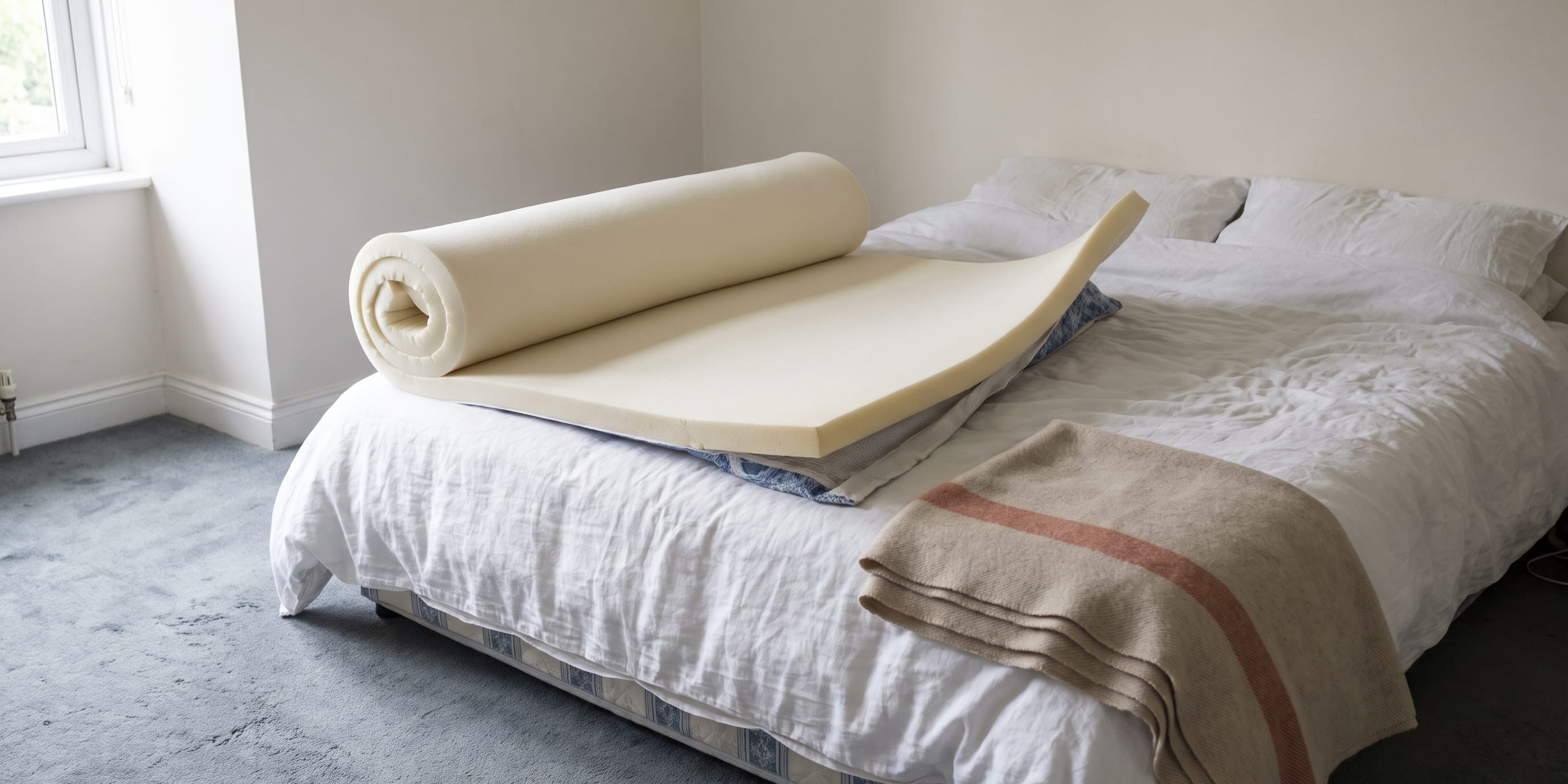
Mattress height. Mattress depth varies widely, and a deep pocket sprung mattress on a tall divan base can put the sleeping surface uncomfortably high. In a small room this matters for two reasons. A high bed visually fills the space and makes the room feel smaller, and it can sit awkwardly in front of a window or radiator. In a loft room with a sloping ceiling, mattress height directly reduces the headroom you have when sitting up in bed.
The practical fix is to think about total height, not just mattress depth. A low platform frame with a medium-depth mattress often suits a small room better than a divan with a deep mattress and a base topper.
Storage bed options: ottoman or divan?
Storage under the bed is one of the best uses of space in a small bedroom, but the two common storage bed types behave very differently.
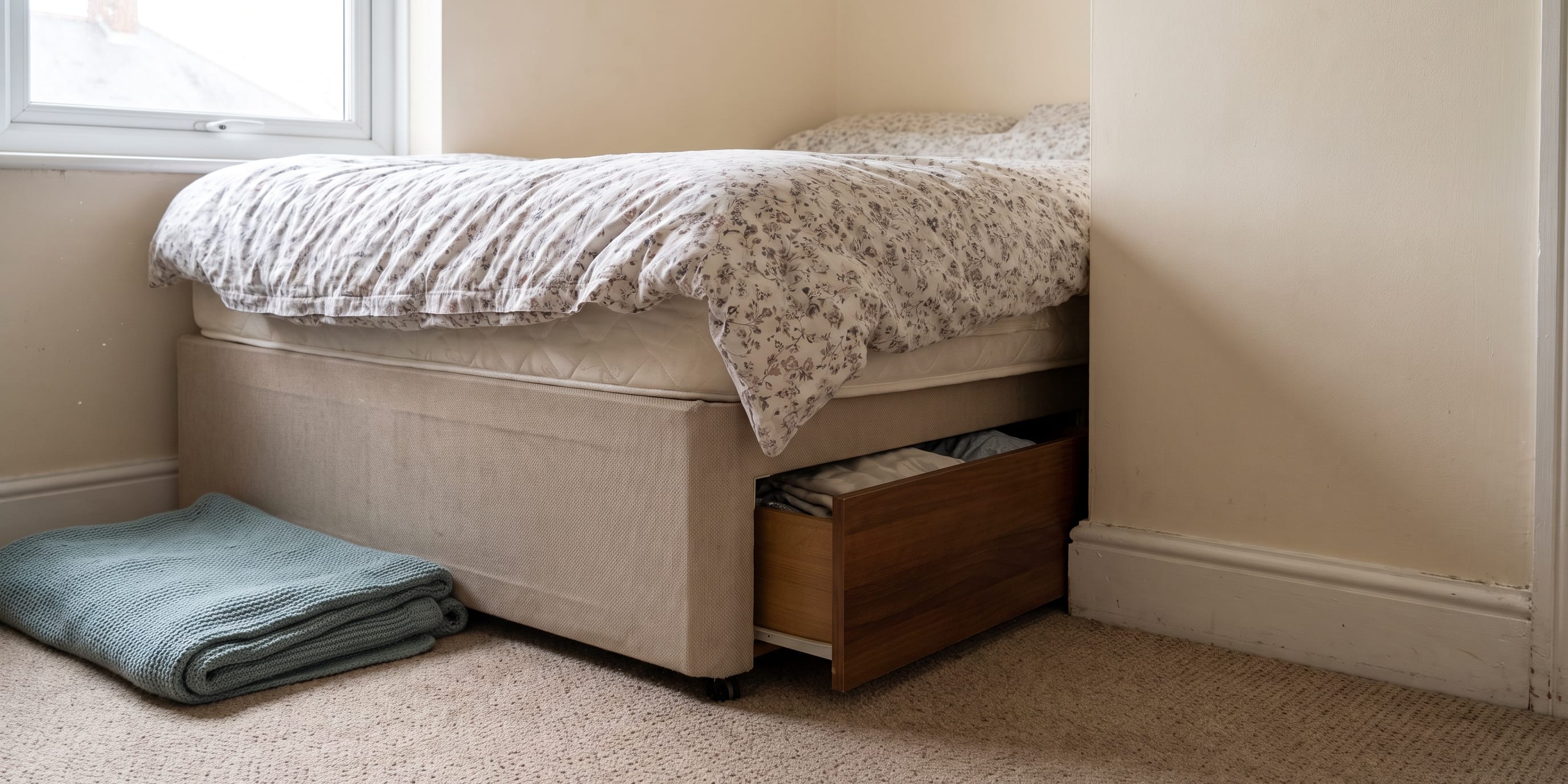
Divan beds with drawers are straightforward and usually cheaper. The catch is that the drawers pull out sideways or from the foot, so you need clear floor in the direction they open. In a room where the bed is squeezed against a wall or a wardrobe, half the drawers become inaccessible. Before choosing a drawer divan, check which sides are genuinely free and buy the drawer configuration that matches. A two-drawer base on the open side is more useful than a four-drawer base where two are permanently blocked.
Ottoman beds lift the whole base upwards on a gas-lift mechanism, giving one large storage compartment underneath. They need no side clearance at all, which makes them well suited to a bed pushed into a corner or an alcove. What they do need is vertical clearance for the base to swing up, plus enough strength and access to lift it. In a loft room with a low sloping ceiling over the bed, a side-opening ottoman may not clear, and an end-opening version may be the only option.
Matching the bed to the room shape
The box room. Typically the smallest bedroom in a UK house, often around 2m by 2.5m, with a door that swings inwards and a radiator under the window. A single (90cm) almost always works. A small double (120cm) can work if the bed runs along the longer wall and the door swing is clear. A standard double usually leaves no usable walkway. Placing the bed lengthways under the window can free up wall space for a wardrobe, provided the radiator is not blocked.
The loft room. The floor area may be generous, but the usable area is defined by where you can stand upright. Beds work well pushed into the low side of the room, since you only lie down there. Measure the headroom at the exact height of the finished mattress surface, not at floor level. Low-profile frames and short or absent headboards come into their own here, and end-opening ottomans avoid clashes with the slope.
The alcove room. A chimney breast creates two alcoves, and a bed tucked into one can look purposeful rather than squeezed. Measure the alcove at its narrowest point, including any pipe boxing, and remember that a bed sitting snugly between two walls can be difficult to make and impossible to fit with drawers that open sideways. This is classic ottoman territory.
Why a proper measure beats guesswork
Bedrooms are rarely square. Walls bow, skirting boards vary in depth, pipe boxing appears where you did not expect it, and the diagonal route from the front door to the bedroom matters just as much as the room itself. A divan base comes in two halves and will go almost anywhere. A solid one-piece frame with a tall headboard may not make it round a tight stairwell turn.
A measuring visit catches all of this before an order is placed. It records the true wall lengths, notes the door swing and radiator positions, checks headroom under a slope, and confirms the delivery route. It also allows a straightforward conversation about the trade-offs: whether rehanging a door buys enough space for a small double, whether sliding wardrobe doors would change the layout, or whether an ottoman solves a drawer access problem. That conversation is much cheaper before you buy than afterwards.
If you are weighing up a single against a small double, or wondering whether a double could work with the right headboard, the sensible next step is to have the room measured and see the frames and bases in person. Take a look at Boundary’s bed range to compare sizes, storage options and headboard styles, and to arrange a measure before you commit to anything.
Questions
Frequently Asked Questions
Will a double bed fit in a box room?
Sometimes, but rarely comfortably. A UK double is 135cm wide by 190cm long, and once you add a headboard and a walking strip down one side you need roughly 2.1m of wall length and around 1.9m of width. Many box rooms are narrower than that, which is why a small double at 120cm wide is often the better answer.
What is the difference between a small double and a double in the UK?
A UK small double (also called a three-quarter or 4ft bed) measures 120cm by 190cm. A standard double is 135cm by 190cm. The 15cm difference sounds minor but it is often exactly the amount of floor you need to open a wardrobe door or walk past the foot of the bed without turning sideways.
How much space do you need to walk around a bed?
Around 55cm to 70cm gives a comfortable walking strip. You can drop to about 45cm on one side if the other side is generous, but below that the gap becomes awkward for making the bed and getting past furniture.
Are ottoman beds a good idea in a small bedroom?
They can be excellent, because they turn the space under the mattress into storage without needing side clearance for drawers. The catch is that the base lifts upwards, so you need clear headroom above the bed, which matters in loft rooms with sloping ceilings.
Should I measure my bedroom myself or have it measured?
You can take useful first measurements yourself, but a professional measure accounts for skirting boards, radiators, door swing, uneven walls and the route the bed has to take to get into the room. Those are the details that cause returns and delivery problems.