Memory Foam Toppers for Mattresses: Do You Need One?
Memory Foam Toppers for Mattresses: Do You Need One, or a New Mattress?
A topper is one of the easiest things in a bedroom to buy and one of the easiest to buy for the wrong reason. It arrives rolled up in a box, it costs a fraction of a mattress, and it genuinely does change how a bed feels the first night you sleep on it. That combination makes it a tempting answer to almost any complaint about a bed.
Sometimes it is the right answer. Often it is a few hundred pounds spent delaying a decision you will still have to make, on a mattress that has already stopped doing its job. The honest version of this advice is not "buy a topper" or "buy a mattress", it is knowing which problem you actually have.
What a memory foam topper actually changes
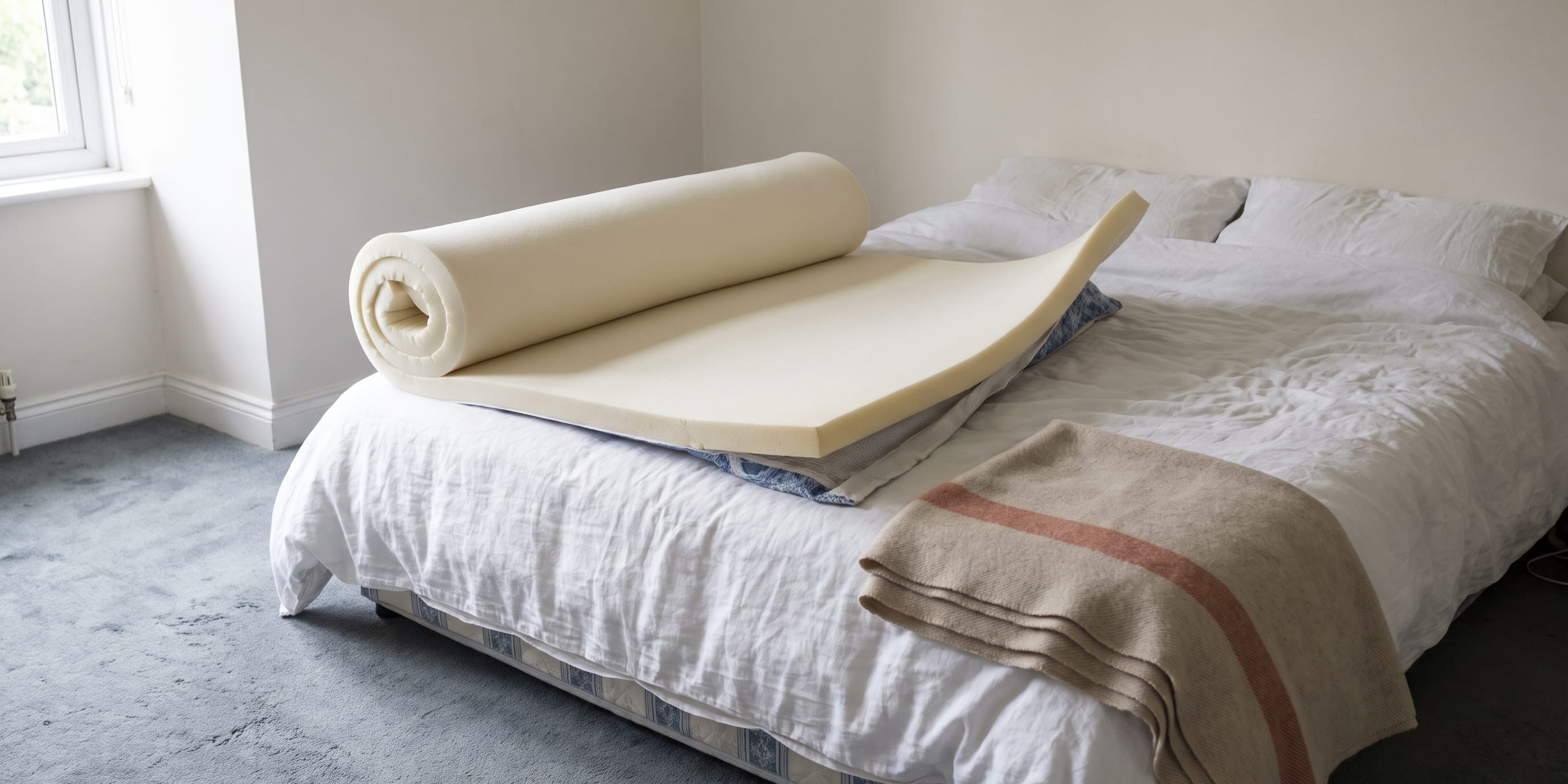
Memory foam toppers for mattresses do one thing well. They add a pressure relieving comfort layer on top of an existing sleeping surface. Memory foam softens in response to body heat and weight, so it spreads your load over a wider area instead of concentrating it at the hips, shoulders and heels. For side sleepers especially, that can take the edge off a mattress that feels unforgiving.
They also change surface feel in ways that have nothing to do with support. A firm mattress can be made to feel more forgiving. A slightly noisy or uneven quilted top can be smoothed out. Movement transfer across the bed is reduced a little, which some couples notice more than they expect.
What a topper cannot do is change what is happening beneath it. Support comes from the spring unit or the core foam of the mattress, and a comfort layer sitting on top has no influence on either. This is the single most important point about toppers and the one most often glossed over. If your spine is not being held in a neutral line because the mattress core has softened or collapsed, a topper will hold your spine in exactly the same wrong position, just with a softer feel at the skin.
A topper also cannot fix a broken or partially collapsed spring unit, cannot restore edge support, cannot undo a mattress that has taken a permanent body impression, and cannot make a mattress hygienic again if the problem is years of accumulated moisture and dust.
Clear signs your mattress needs replacing instead
Some indicators are unambiguous. If you can see or feel individual springs through the upholstery, the mattress is finished. If the sides have gone soft enough that you feel you might roll off, or the edge collapses when you sit on it to put your socks on, the frame of the mattress has failed.
Sagging is the classic one. Strip the bed, look across the surface at eye level from the foot end and see whether there are visible dips where you and your partner sleep, particularly a ridge left standing between them. A dip you can see is a dip a topper will simply drape into. Press down firmly in the middle of a dip: if it feels hollow or hits something hard quickly, the upholstery layers have compacted beyond recovery.
Age is a blunt instrument but a useful one. Mattresses have a working life, and after enough years the materials have lost a meaningful amount of their original resilience even if nothing looks dramatically wrong. If you genuinely cannot remember when you bought it, that is its own answer.
Then there is pain. Waking with lower back stiffness that eases within half an hour of getting up is a common pattern where the mattress is not supporting the lumbar curve properly. The timing question matters more than the symptom: did the discomfort start or clearly worsen after a particular period of using this mattress? If so, a topper is unlikely to be the fix. If your back has been fine for years and you have simply started finding the surface too firm, that is a comfort complaint and a topper is a reasonable response. Persistent or worsening pain is always worth raising with a GP or physiotherapist rather than treated as a shopping problem.
One more test. If you sleep noticeably better in a hotel bed or a spare room bed, the mattress at home has told you what it thinks.
Thickness and density: what the numbers mean
Thickness and density are separate things and people conflate them constantly.
Around 2cm. A surface treatment. It changes how the bed feels to the touch and takes the slight harshness off a firm mattress. It will not provide meaningful pressure relief for the hips or shoulders. Useful if you are broadly happy with your mattress and want a small tweak, or if you want a washable barrier layer with a little softness.
Around 5cm. The most widely useful depth and the point at which memory foam starts behaving the way people imagine. There is enough material for your body to sink in and be cradled rather than just cushioned. This is the sensible choice for genuine pressure relief on a mattress that is still structurally sound.
8cm and above. A deep, enveloping feel that some people love and others find restrictive. The trade-offs are real: more foam means more heat retention, more weight to handle when you change the bed, and a tendency to make getting in and out of bed feel like more effort. Deep toppers can also cause fitted sheets to strain and slip, so check your bedding will cope.
Density is the quieter number and it governs both support and durability. Lower density foam feels softer immediately and loses its shape sooner. Higher density foam is more supportive, slower to respond and lasts longer, but sleeps warmer and feels firmer on a cold night. A thick low density topper is a common disappointment: it feels luxurious in the shop and bottoms out under the hips within months. If you are choosing between an extra couple of centimetres and a better density, take the density.
Compatibility with your existing mattress
Pocket sprung. A good match, provided the mattress is still even. The one caveat is that a thick topper will partly mute the independent spring response, which is the thing you paid extra for. On a pocket sprung mattress, a 2cm to 5cm topper usually makes more sense than a deep one.
Orthopaedic and firm mattresses. This is the most common successful use of a topper. A very firm mattress often provides excellent support and a punishing surface, and a memory foam layer resolves that mismatch neatly. Choose a medium to high density topper so the foam does not simply compress flat against the firm core.
Older divan mattresses. Be cautious. Traditional open sprung divan mattresses often develop the exact problems a topper cannot address: compacted fibre upholstery, body impressions and softened edges. Check the base as well. A sagging divan base or broken slats will undermine any mattress and any topper on top of it.
Foam and hybrid mattresses. These already have engineered comfort layers, so adding another can make the whole thing feel vague and sink prone. If a relatively new foam mattress is uncomfortable, the firmness choice was probably wrong and a topper is a patch, not a correction.
Care, lifespan and the heat question
Memory foam does not like water. Most toppers cannot be washed, so a removable cover or a mattress protector over the top is essential rather than optional. Spot clean sparingly with a barely damp cloth and let it dry completely, because trapped moisture inside foam is very difficult to shift.
Toppers cannot be turned over, since only one face is the comfort surface, but you can and should rotate head to foot every couple of months to spread the wear. Air the topper when you change the bedding: memory foam holds body moisture, and an hour uncovered makes a genuine difference.
Expect a shorter life than a mattress. A topper is thin, takes the full load at the surface and cannot be flipped, so the foam softens sooner. Treat it as a comfort item with a finite life rather than a long term investment, and factor that into whether it is really the cheaper option.
On heat, be realistic. Memory foam works by moulding closely around you, and that same behaviour reduces airflow and traps warmth. Gel infusions, open cell structures and perforated designs all help, and they are worth having, but none of them turn memory foam into a cool sleeping surface. If you already sleep hot, a thinner topper or a different material is the more honest recommendation.
If your mattress is past the topper stage
If you have looked across your mattress and seen dips, felt springs, or traced back the start of your morning stiffness to this bed, the money is better spent on the mattress itself. A topper on a failing mattress costs you twice: once for the topper, and again when you replace the mattress anyway and find the topper no longer suits it.
The useful next move is to get proper mattress advice before you look at anything: a conversation about how you actually sleep, your weight, your usual position, whether you sleep hot, and what your current bed gets wrong. That narrows the field far faster than reading firmness ratings on labels. You can browse Boundary’s mattress range to see what is available, and ask for mattress advice on whether a topper or a full replacement is the sensible spend in your case.
Questions
Frequently Asked Questions
Will a memory foam topper fix a sagging mattress?
No. A topper follows the shape of whatever is underneath it, so a dip in the mattress becomes a dip in the topper. It may feel softer for a few weeks, but the lack of support underneath stays exactly the same.
What thickness of memory foam topper should I choose?
Around 2cm changes the surface feel only. About 5cm is the usual choice for genuine pressure relief on a mattress that is still supportive. 8cm and above is for people who want a deep, enveloping feel and are happy with a warmer, heavier topper.
Do memory foam toppers sleep hot?
Traditional memory foam does retain warmth because it moulds closely around the body and restricts airflow. Gel infused and open cell foams reduce this, but no memory foam topper will sleep as cool as an open sprung mattress with a natural fibre cover.
How long does a memory foam topper last?
Expect a shorter working life than a mattress. Toppers are thinner, take the full load of your body weight at the surface and are not turned, so the comfort layer softens sooner. Density matters more than thickness for longevity.
Can I use a memory foam topper on a pocket sprung mattress?
Yes, and it is one of the better pairings, as long as the mattress itself is still even and supportive. Be aware that the topper will slightly mask the individual spring response you paid for.