
Divan Beds with Headboards: How to Choose the Right Match
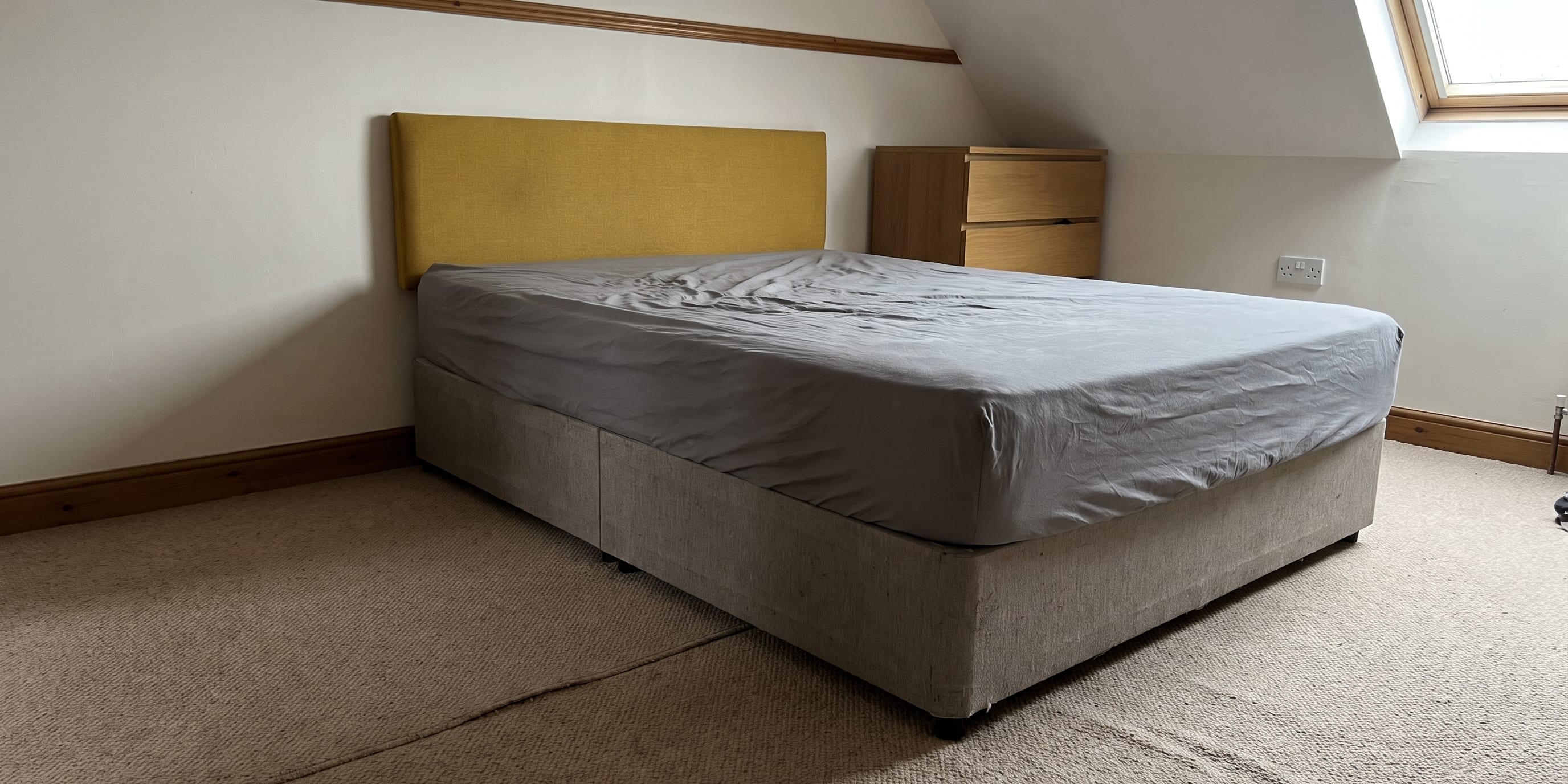
A divan base and a headboard are sold as two separate things far more often than people expect. That is fine when they are ordered together as a set, because the manufacturer has already done the matching. It becomes a problem when a headboard is bought on its own, arrives in the right fabric and the right bed size, and still does not fit the base properly.
Most of those mismatches come down to four decisions: the type of headboard, its height, its width, and how it attaches. Get those right and the rest is straightforward. This guide works through each one in the order you will actually need to think about them.
Strutted and floor-standing headboards are not interchangeable
Headboards sold for divan beds fall into two broad families, and they behave very differently.
A strutted headboard has two legs, or struts, running down from the back of the panel. Those struts bolt directly onto the head end of the divan base. The headboard is carried entirely by the base, so nothing touches the floor and nothing needs to clear the skirting board. The bottom portion of the panel sits behind the mattress and is hidden, which matters for the height calculation later on. Strutted headboards are the standard option for divans and tend to be the more economical of the two.
A floor-standing headboard has legs that continue all the way down to the floor. It stands behind the bed on its own, held in place by the weight of the base pushed up against it, and in many designs it can also be bolted to the base for extra stability. Floor-standing designs are usually taller and often wider than the bed itself, which gives a more upholstered, furniture-like look.
Which one suits your base comes down to one question: does the base have fixing points? Strutted headboards need bolt holes at the head end. If your base has them, either type will work and the choice is aesthetic. If it does not, a floor-standing headboard is the practical answer, because it needs no attachment to work.
There is one more thing to check with storage bases. Drawer divans and ottoman divans both take headboards perfectly well, but on a floor-standing design you need enough clearance behind the bed, and on a side-opening drawer base you need to be sure that nothing is obstructed when the bed is pushed back against the headboard legs. If the bed sits in an alcove, work this out before you order rather than after.
Height: work out what will actually be visible
The height quoted on a headboard listing is the overall height of the panel and struts together. That is not the height you will see once the bed is made up.
With a strutted headboard, the struts bolt to the base, so the bottom of the panel sits at roughly base-top level. Your mattress then covers the lower part of it. The visible height is therefore the overall height minus your mattress depth, give or take the adjustment built into the struts. As an example, a headboard listed at 120cm with a 28cm mattress in front of it leaves a little over 90cm showing. Swap in a deeper mattress and the headboard shrinks visually without you changing anything.
This is why mattress depth matters when you are choosing. A deep pocket sprung mattress with a pillow top can swallow a surprising amount of a shorter headboard. Many strutted designs have two or three sets of holes drilled into the struts so you can raise or lower the panel, which gives you some room to correct this, but it is not unlimited.
Then consider the room. A tall headboard reads as generous and hotel-like in a room with decent ceiling height. In a bedroom with a low ceiling, a sloping eaves wall, a picture rail, or a window directly above the bed, the same headboard can look cramped or simply will not clear the obstruction. Floor-standing designs in particular are often quite tall, so measure from the floor to whatever is above the bed before committing.
Total bed height plays into this too. A high base on castors with a deep mattress sits noticeably taller than a low platform base with a slimmer mattress, and the headboard needs to be in proportion with the whole thing rather than considered on its own.
Width: match the bed size, then check the wall
UK divan sizes are standard, and headboards are made to match them:
- Single, 3ft, 90cm wide
- Small double, 4ft, 120cm wide
- Double, 4ft6, 135cm wide
- King, 5ft, 150cm wide
- Super king, 6ft, 180cm wide
A strutted headboard in a given size will normally be made to that exact width, so a king headboard lines up flush with a king base. The size on the label is the size you need.
Floor-standing headboards are the exception. Many are deliberately made wider than the bed so they frame it, and some are considerably wider. The product dimensions will give an overall width that is larger than the bed size in the title, and that overall figure is the one that has to fit your room. If the bed sits between a chimney breast and a wall, or between two alcoves, measure the gap at headboard height rather than at floor level, because skirting boards, dado rails and pipework can all narrow it.
One further point on super king and king beds. Larger divan bases usually split into two halves for delivery and are then clipped together. The headboard still spans the full width as a single piece, so check that it can be carried up your stairs and around any tight landing. A 180cm panel is awkward in a narrow hallway.
Buying as a set or adding a headboard later
Buying the divan and headboard together as a matched set is the simplest route, and usually the better value one. The fabric is from the same range, the fixings are supplied with the base, the strut spacing is correct and the proportions have been designed to work together. Nothing has to be cross-referenced.
Adding a headboard later is entirely reasonable if you want to spread the cost or you are still deciding on a look. Two things make it go smoothly. First, note down the exact bed size and the base model and fabric at the time of purchase, because matching a fabric from memory months later rarely works. Second, confirm the base has fixing points and measure the distance between them. Fabric ranges do get discontinued and weave batches do vary slightly, so if an exact match matters to you, buying together is the way to guarantee it.
A middle option worth knowing about is to choose a deliberately contrasting headboard rather than attempting a near match that lands slightly off. A velvet or linen-look headboard in a different colour to the base often looks more considered than two greys that do not quite agree.
How headboards fix to a divan base
On a strutted headboard, each strut has a slot or a line of holes. These line up with bolt holes in the timber frame at the head end of the divan, with the bolts and washers normally supplied with the base rather than with the headboard. You slide the struts down the back of the base, line up the holes at the height you want, and tighten the bolts. It is a two person job mainly because of the weight and the awkwardness, not because it is complicated.
If you are retrofitting to an existing bed, look at the head end of the base first. You are looking for either bolt holes through the fabric into the frame, or threaded metal inserts. If there is nothing there, do not assume you can simply drill your own. On some bases the timber at that point is not substantial enough to carry a headboard safely, and drilling through an upholstered panel to find out is not a good test. A floor-standing headboard avoids the question entirely.
Measure before you order, not after it arrives
Headboards are bulky to return, and a mismatch is usually discovered at the point where everything else is already assembled. A short measuring session prevents almost all of it. Before ordering, record:
- The bed size you have or are buying, in feet and centimetres
- Mattress depth, to work out visible headboard height
- Floor to ceiling height above the bed, plus the height of any sill, radiator or rail behind it
- Wall width available at headboard height, including skirting and any alcove narrowing
- Whether the base has headboard fixing points, and the spacing between them
- Access measurements for stairs, landings and doorways
Take those figures with you when you compare options and the decision becomes mechanical rather than hopeful.
If you would like help pairing a base, mattress and headboard that genuinely work together, it is worth looking through Boundary’s bed range with your measurements in hand so you can check the fit of each combination before you order.
Questions
Frequently Asked Questions
Do all divan bases have holes for a headboard?
Most modern divan bases are supplied with pre-drilled fixing points at the head end, usually two on each side, along with the bolts needed. Older bases, budget bases and some storage bases may not have them. Check before you buy a strutted headboard, because a floor-standing design is the safer choice where there are no fixing points.
Can I add a headboard to a divan bed I already own?
Often yes. Look at the head end of the base for bolt holes or threaded inserts, and note how far apart they are. If they are there, a strutted headboard in the matching bed size should fit. If they are not, a floor-standing headboard stands on the floor behind the bed and needs no fixing at all.
Should the headboard be the same width as the divan bed?
Strutted headboards are normally made to the exact bed width, so a 4ft6 double headboard matches a 4ft6 base. Floor-standing designs are frequently wider than the bed by design, so check the overall width in the product dimensions and make sure it will still fit your wall or alcove.
Is it cheaper to buy a divan and headboard together?
A matched set is usually better value than buying the two separately, and it removes any risk of the fabrics or fixings not lining up. Buying the headboard later is still perfectly workable if you need to spread the cost, as long as you keep a note of the base size and fabric.
How high should a headboard be above the mattress?
There is no single correct figure, but the visible part should look balanced against the mattress and the wall behind. Subtract your mattress depth from the headboard’s overall height to see how much will actually show, then check that against window sills, radiators and picture rails.